Database reactivation: the money already in your phone

Automations


Every quote you sent that never came back is still sat in your phone. So is every customer you did a job for in 2023 and never spoke to again. Most trades have a few hundred of these and treat them as dead.
They are not dead. Every one of them picked up the phone and rang you at some point. Nobody in a Facebook audience has ever done that.
This is how we run a reactivation, including the part almost every "hack" version of this leaves out, which is the law.
Start with what's actually in there
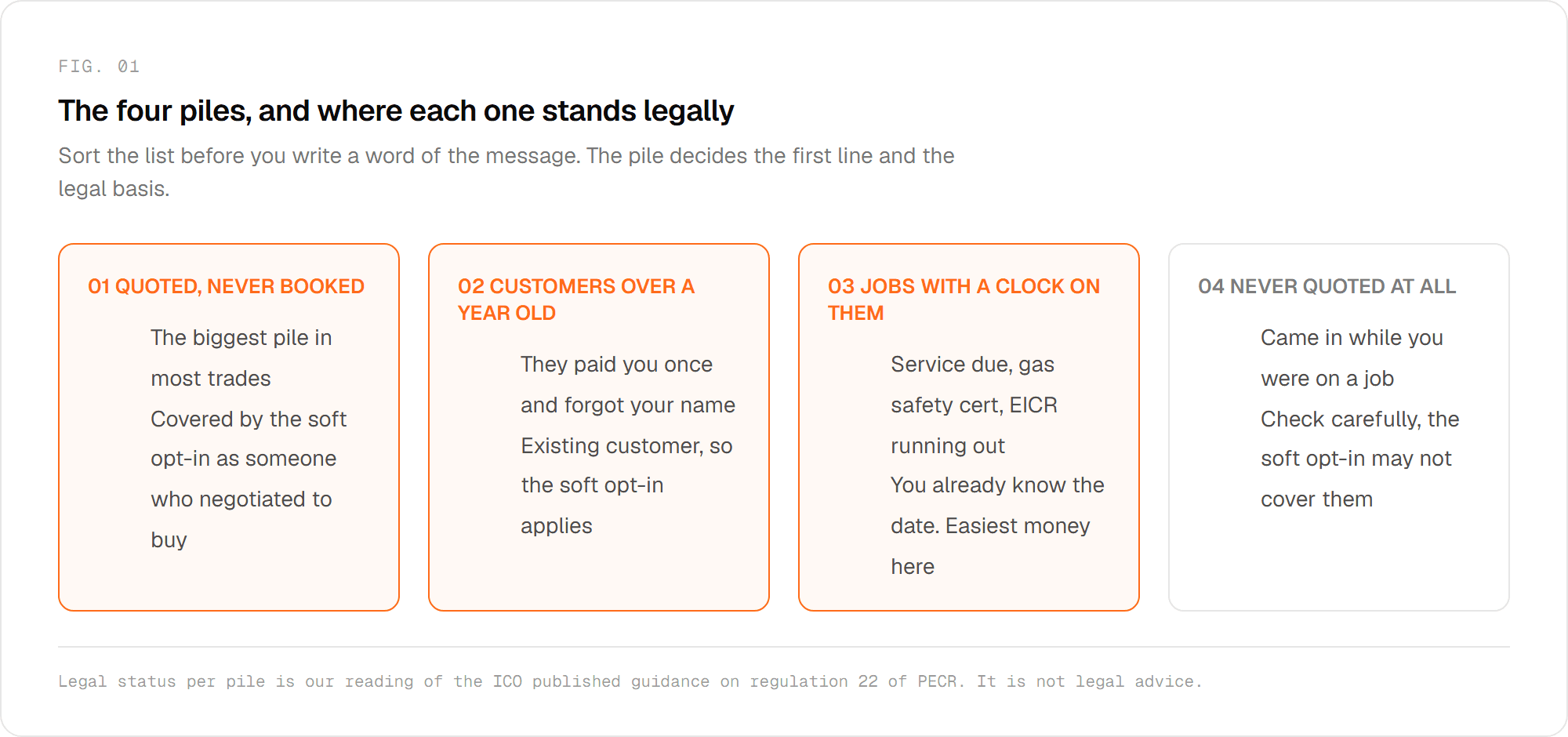
Before anything else, go and count. Four piles:
Quoted, never booked. The big one. They wanted the work doing, they got your price, then it went quiet. Nobody rang them again.
Customers from more than a year ago. They liked you enough to pay you. They have almost certainly forgotten your name.
Jobs with a clock on them. Boiler serviced in October last year, gas safety certificate on a rental, an EICR that runs out in year five. You already know the date.
Enquiries you never quoted at all. The ones that came in while you were on a job and never got picked back up.
Pile 3 is the easiest money in this entire article and most trades ignore it, because the customer has no reason to think about it and you do.
The legal bit, because this is where people get it wrong
In the UK, texting and emailing marketing to people is governed by PECR, the Privacy and Electronic Communications Regulations, and it is the Information Commissioner's Office that enforces it. Regulation 22 is the one that matters.
The ICO's own guidance says you must not send marketing emails or texts to individuals unless:
"they have specifically consented to electronic mail from you"; or
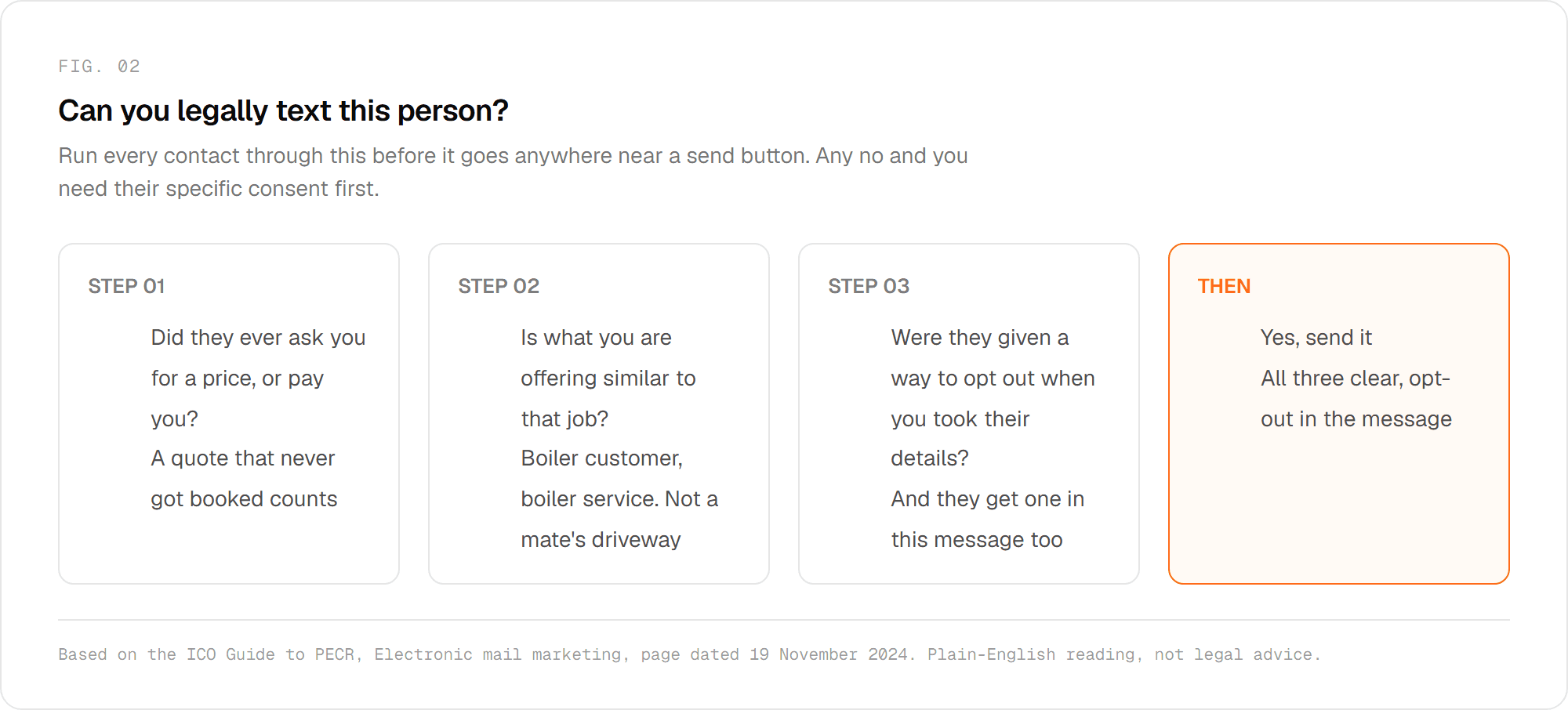
"they are an existing customer who bought (or negotiated to buy) a similar product or service from you in the past, and you gave them a simple way to opt out both when you first collected their details and in every message you have sent."
That second one is the soft opt-in, and it is the entire basis of a legal reactivation campaign for a trade business. Three things about it are worth reading slowly.
"or negotiated to buy" covers your quotes. Somebody who asked you for a price and never booked has negotiated to buy. Your quoted-never-booked pile is inside the rule. That is the single most valuable line in the regulations for a trade.
"similar product or service" means what you already do. A gas engineer texting a past boiler customer about a service is fine. The same engineer texting them about a mate's driveway business is not.
"electronic mail" is broader than email. The ICO defines it to cover "emails, texts, picture messages, video messages, voicemails, direct messages via social media". WhatsApp marketing is in scope. So is a voicemail drop.
Two more that catch people out:
The soft opt-in "does not apply to prospective customers or new contacts (eg from bought-in lists)". A list you bought is not reactivation. Do not touch it.
Sole traders and some partnerships are treated as individuals, not as companies. So the "you can email any business" shortcut does not cover the plumber down the road.
Every message needs a way out, every time. Not just the first one.
The penalty side has moved recently. The Data (Use and Access) Act 2025 lifts the maximum PECR fine from £500,000 to £17.5 million or 4% of worldwide turnover, whichever is higher. As at the legal briefings I have read, the schedule carrying that increase had not been fully commenced, so check where it stands before you quote it at anyone. The direction is not in question.
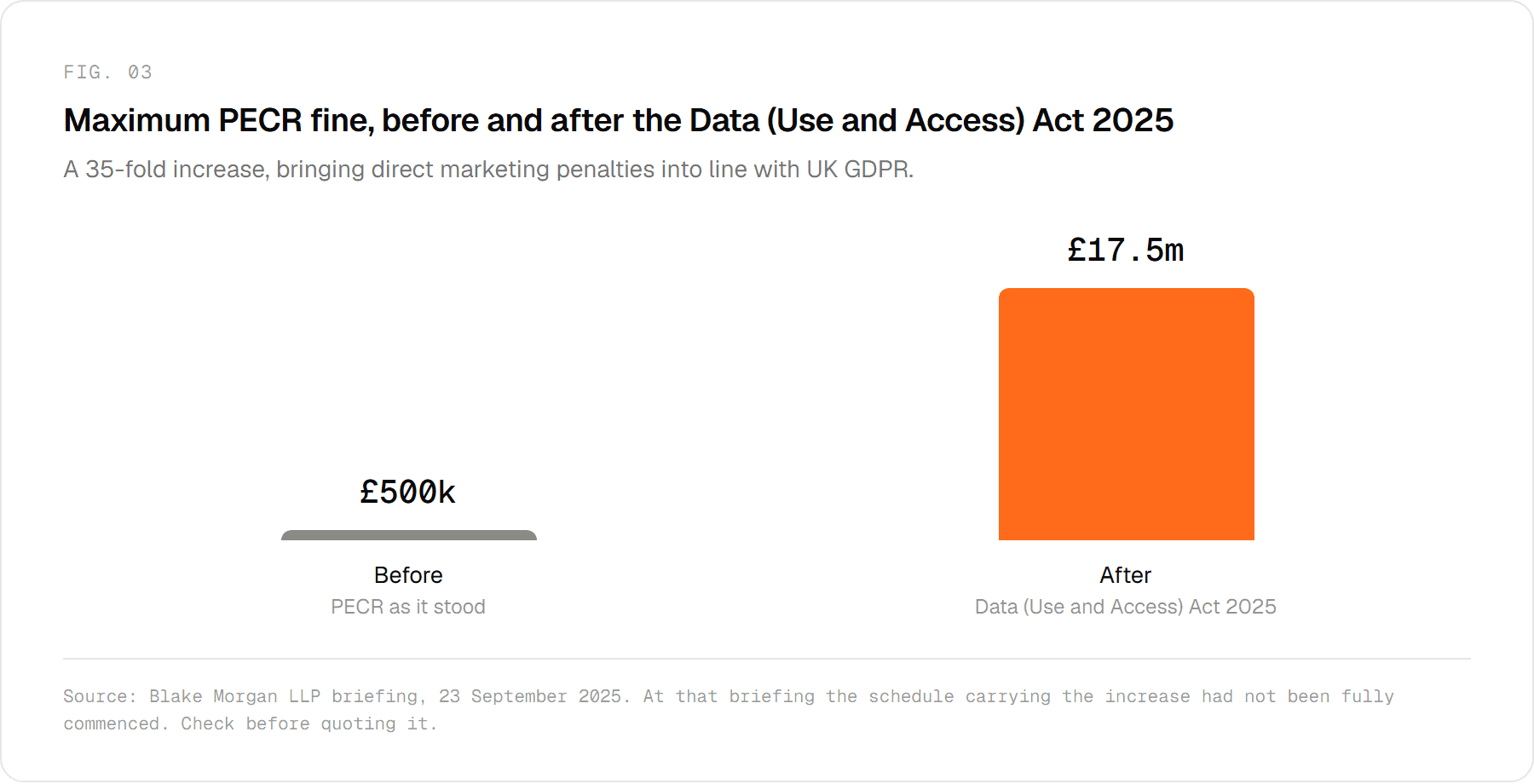
You are not going to get fined £17.5m for texting 200 old customers. The reason to get this right is that doing it properly and doing it sloppily take about the same amount of effort, and only one of them holds up if somebody complains.
Why the maths is so lopsided
A reactivation costs you the price of the messages. Everything else you do to get work costs you the price of the lead.
Text messages are pennies each. Email is effectively free. So the cost of putting an offer in front of 400 people who already know your name is roughly the cost of a bag of chips, and the only real input is the hour it takes to write it and check the list.
Compare that with anything else. A directory lead, a Google click, a Meta lead form. You pay per lead, every time, whether or not they were ever going to book.
I have deliberately not put a benchmark reply rate in that calculator. There are a lot of numbers floating about for this and I have not found one from a real UK trades dataset that I would put my name to. Run it on your own list and you will have a better number than any of them within a fortnight.
What the message has to be
Short, from your mobile number, about them, and asking one question.
The version that works looks like a text from a person, because it is one:
Hi Sarah, Matt here from [business]. I quoted you for the bathroom back in March. Are you still looking to get that done? If it's easier I can do you a fixed price this month. Reply STOP if you'd rather I didn't message.
That is it. No offer stack, no countdown, no "we hope this finds you well". One question, easy to answer with one word.
Things that kill it:
Sending it from a five-digit shortcode. It reads as marketing and gets deleted.
Sending the same message to all four piles. A past customer and a cold quote need different first lines.
Asking them to click a link as the first action. Ask a question, get a reply, then send the link in the conversation.
Sending it and then not being ready. If forty people reply on a Tuesday morning and you are up a ladder, you have made your missed-call problem worse. See the other article.
The order we run it in
Export and clean. Dedupe, drop anyone who ever opted out, split into the four piles.
Check consent pile by pile. Anyone who does not clear the soft opt-in test does not get messaged. Not "probably fine".
Message the smallest pile first. Usually the service-due list. It is the warmest and it tells you whether your replies are landing before you spend the big list.
Answer replies same day. This is the whole campaign. A reactivation with slow replies is just annoying people.
Then the quoted-never-booked pile, in batches you can actually handle. 50 at a time, not 400.
Put the ones who say "not right now" on a date. They said not now, not never. That is a diary entry, not a dead lead.
What this article does not claim
I have not quoted a reply rate, a conversion rate or a "reactivation typically returns £X per £1" figure, because I could not find one from a UK trades dataset with a method attached. The ones circulating online mostly trace back to nothing.
The legal section is a plain-English read of the ICO's published guidance, not legal advice. The guidance itself carries a note that it is under review following the Data (Use and Access) Act.
Cost per message varies by provider and by whether you are on a business messaging platform or your own phone.
The review request and the follow-up texts described here run automatically for our clients. How that is wired, including the STOP handling, is on the automations page.
Sources
Information Commissioner's Office, Guide to PECR: Electronic mail marketing. Page dated 19 November 2024. All quoted wording is the ICO's.
Blake Morgan LLP, "Data (Use and Access) Act 2025 - Privacy and Electronic Communications Regulations", 23 September 2025, by Bethan Taylor and Ellie Cater.

Matthew Betts

