What a missed call actually costs you

Missed calls


You're under a sink with your arm in a cupboard when the phone goes. You can't get to it. You ring back forty minutes later, it goes to their voicemail because they're at work, and by teatime someone else has been out and quoted.
Nobody writes that down. There's no line in your accounts called "jobs I never knew about". So it carries on.
This is what the numbers actually say about it, where they come from, and what to do about it that isn't "hire a receptionist".
Most people who get your voicemail just hang up
Moneypenny, a telephone answering company in Wrexham, ran a survey of 300 micro businesses (0 to 9 employees) and examined call data from 10,000 businesses. Two findings from it matter here.
A third of the businesses surveyed, 33%, failed to answer their incoming calls.
And of the callers who got through to voicemail, 69% declined to leave a message and hung up.
Read the second one again, because it is the one that costs money. Seven in ten of the people who ring you and get voicemail do not leave a message. They are not annoyed with you. They just want the job doing, so they go back to the search results and ring the next name.
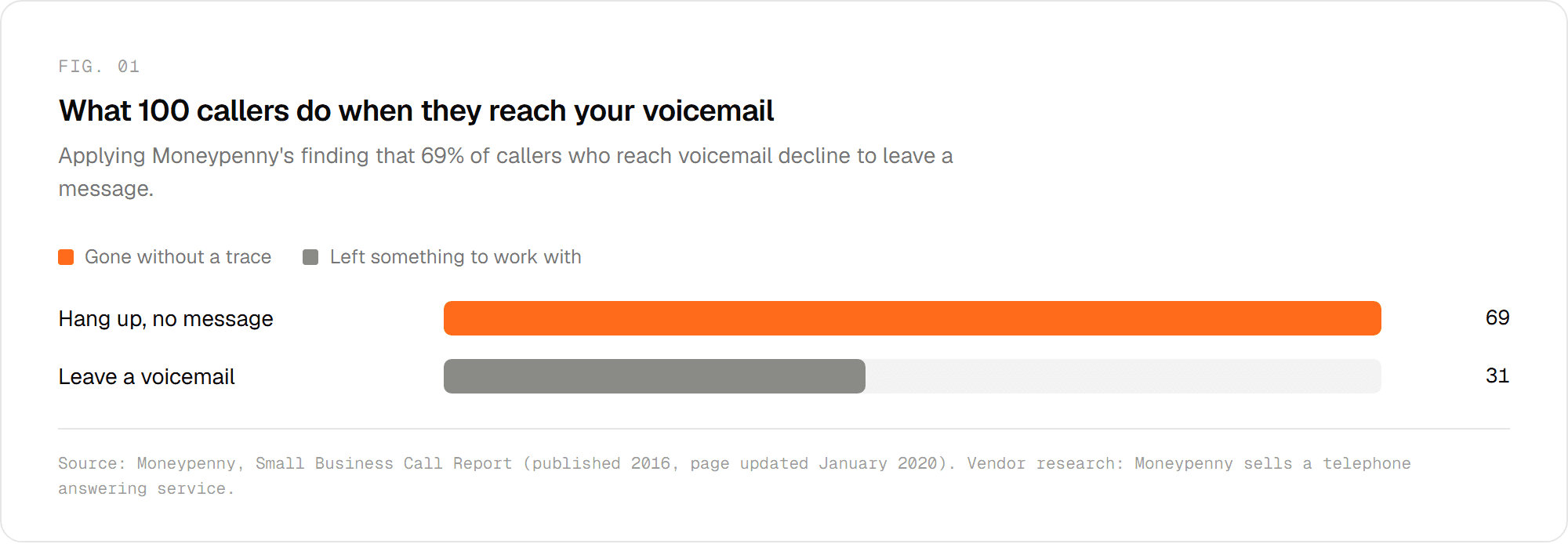
That is why the missed-call log on your phone is not a list of people who will ring back. For most of them it is a list of jobs that went to someone else, and the only reason you can see them at all is that your phone recorded the number.
It is worth saying plainly that Moneypenny sells a phone answering service, so they had a reason to publish this. I have still not found a better UK dataset on it, and the 69% figure matches what happens on our clients' numbers when we start tracking calls properly.
What one of those calls is worth
Moneypenny ran a second survey with Censuswide in November 2019, 2,000 UK and US businesses. 57% of them put the average value of losing a ready-to-buy call to a competitor at more than £1,000.
That was businesses of every size guessing at their own number, so treat it as a sense-check rather than a fact about your business. Your number is easier to work out than theirs, because you know what you charge.
Checkatrade's cost guide, last updated March 2026, puts a like-for-like combi swap at £2,500 to £4,000 supply and fit. So if you are a gas engineer, one missed call that was a boiler swap is somewhere around three grand of work, and your margin on it is your margin.
Put your own numbers in.
Ringing back tomorrow is nearly the same as not ringing back
The other half of this is speed, and the best study on it is old but it has never been beaten for sample size.
Oldroyd, McElheran and Elkington published "The Short Life of Online Sales Leads" in Harvard Business Review in March 2011. They audited 2,241 US companies by sending each one a web enquiry and timing the reply.
37% responded within an hour. 16% within one to 24 hours. 24% took more than 24 hours. 23% never responded at all. Among the companies that did respond within 30 days, the average response time was 42 hours.
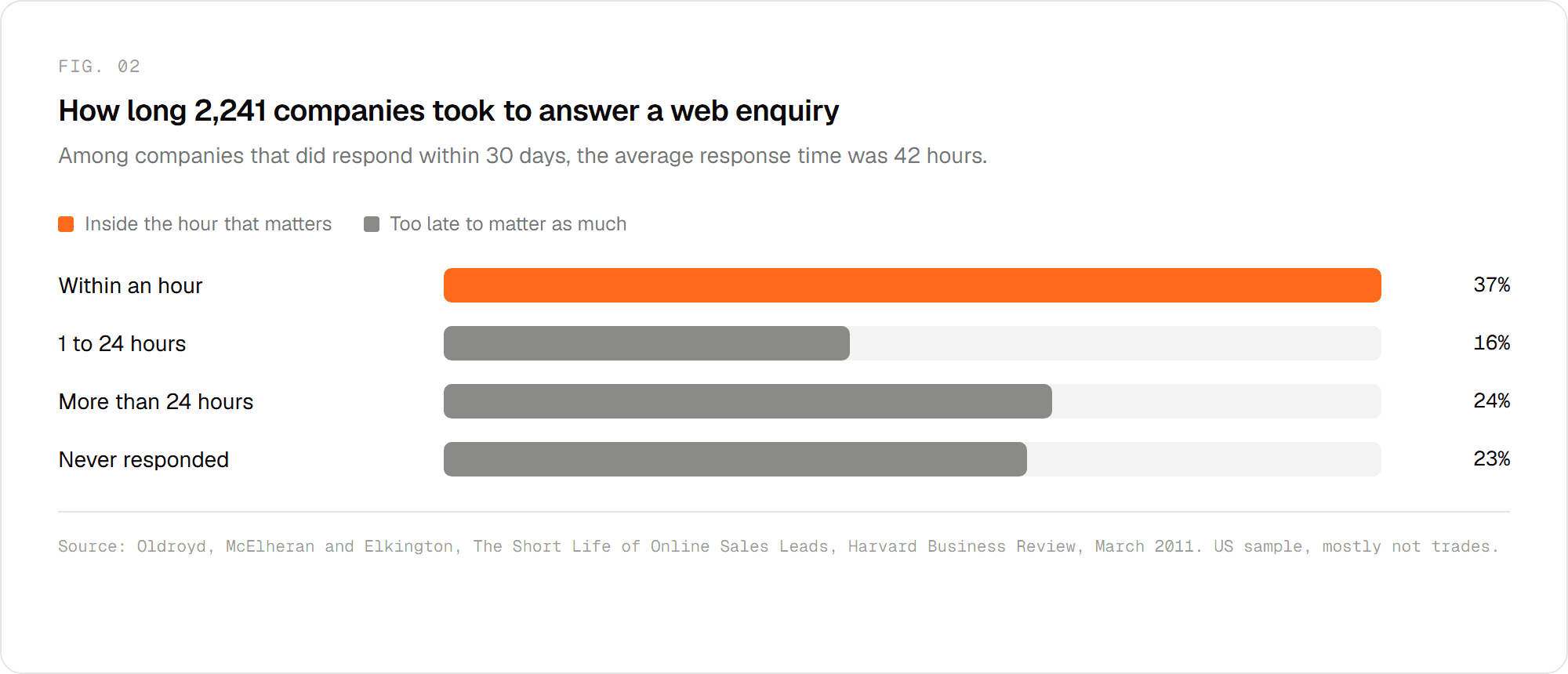
They also found that firms who tried to contact customers within an hour of the enquiry were nearly seven times as likely to qualify the lead, which they defined as having a meaningful conversation with a key decision maker, as those who tried an hour later.
That is a US study from 2011 and the companies in it are mostly not trades. I am not going to pretend it is a UK plumbing number. What it tells you is the shape of the thing: the value of a lead falls off a cliff in the first hour and then keeps falling, and everyone in your trade is losing work in the same window.
For trades the window is probably tighter than an hour, not looser, because a homeowner with a leak is ringing three people off the map in about four minutes.
What actually fixes it
Not a receptionist. A receptionist is a fine answer if you can afford one and most one and two-van outfits can't, and it doesn't help at 7pm.
The order we do it in, on every client we take on:
An automatic text back the second a call is missed. This is the one that pays for itself in the first fortnight. The caller's phone buzzes while they are still holding it, with a message from your number saying you're on a job and asking what they need. Now the 69% who would have hung up have something to reply to, and you have their problem in writing before you've climbed out of the loft.
Somewhere for the reply to land that isn't your personal messages. If the reply goes into the same thread as your mother and the football group chat, it gets lost by Thursday. It goes into a proper inbox with the job attached to it.
A rule about who rings back and when. Not "when I get a minute". A named time. Most of our clients do end of job and end of day.
Track it, or none of the above is real. Every client we run has call tracking on so we can see calls in, calls answered, calls missed, and what happened after. Without that you are guessing, and the guess is always flattering.
Then, and only then, look at whether more leads is even your problem. Plenty of trades who think they need ads need to answer the phone. It is cheaper to fix and it works faster.
The bit most people skip
You already have the missed calls. They are in your phone right now, going back months. Before you spend a penny on advertising, scroll back through them.
[MATTHEW: put a real number here if you have one. e.g. "when we did this for a client in [town] we found [n] missed calls in [period]". Leave it out rather than make it up.]
What this article does not claim
I would rather be straight about the limits than have a gas engineer quote a number at me that turns out to be made up.
The Moneypenny 33% is the share of businesses that failed to answer calls. It is not "a third of all calls are missed". Nobody has published a reliable figure for that in UK trades that I can find.
Both Moneypenny surveys were commissioned by a company that sells telephone answering. Real fieldwork, real samples, but it is vendor research and I have labelled it as such.
The Harvard Business Review audit is US, 2011, and mostly not trades.
There is a lot of UK missed-call content online quoting figures like "47% of calls to UK SMEs go unanswered" and "£X billion lost a year". I went looking for the studies behind several of those and could not find them. They are not in this article.
If you want to see the fix rather than the numbers, the missed-call text-back, the WhatsApp assistant and the booking hand-off are laid out step by step on our automations page.
Sources
Moneypenny, Small Business Call Report. Published 21 November 2016, page last updated 27 January 2020. Independent survey of 300 micro businesses (0 to 9 employees) plus call data from 10,000 businesses.
Moneypenny / Censuswide, survey of 2,000 UK and US businesses, fieldwork 15 to 25 November 2019.
James B. Oldroyd, Kristina McElheran and David Elkington, "The Short Life of Online Sales Leads", Harvard Business Review, March 2011 (vol 89 no 3).
Checkatrade, New Boiler Costs cost guide, last updated March 2026. Checkatrade describe their cost guides as ballpark averages.
Do the maths

Matthew Betts

