Where UK customers actually look for a trade now

Visibility


A homeowner with a dead boiler in February does not open a browser and think about marketing channels. They pick up the phone they were already holding and they look in about four places, and which four has changed in the last two years.
Ofcom publishes the best public data on this. Their Online Nation report came out on 10 December 2025 and it is the closest thing the UK has to an official record of where people's attention goes. Here is what it says, and what it means if you fit boilers in Bridgend.
The two companies that own the attention
Ofcom's headline: two firms now account for more than half of all the time people in the UK spend online. Alphabet and Meta.
The reach numbers underneath that:
YouTube, used by 94% of UK adults
Facebook and Messenger together, 93%
WhatsApp, 90%
Google Search, 82%, and Ofcom put it at 3 billion searches a month in the UK
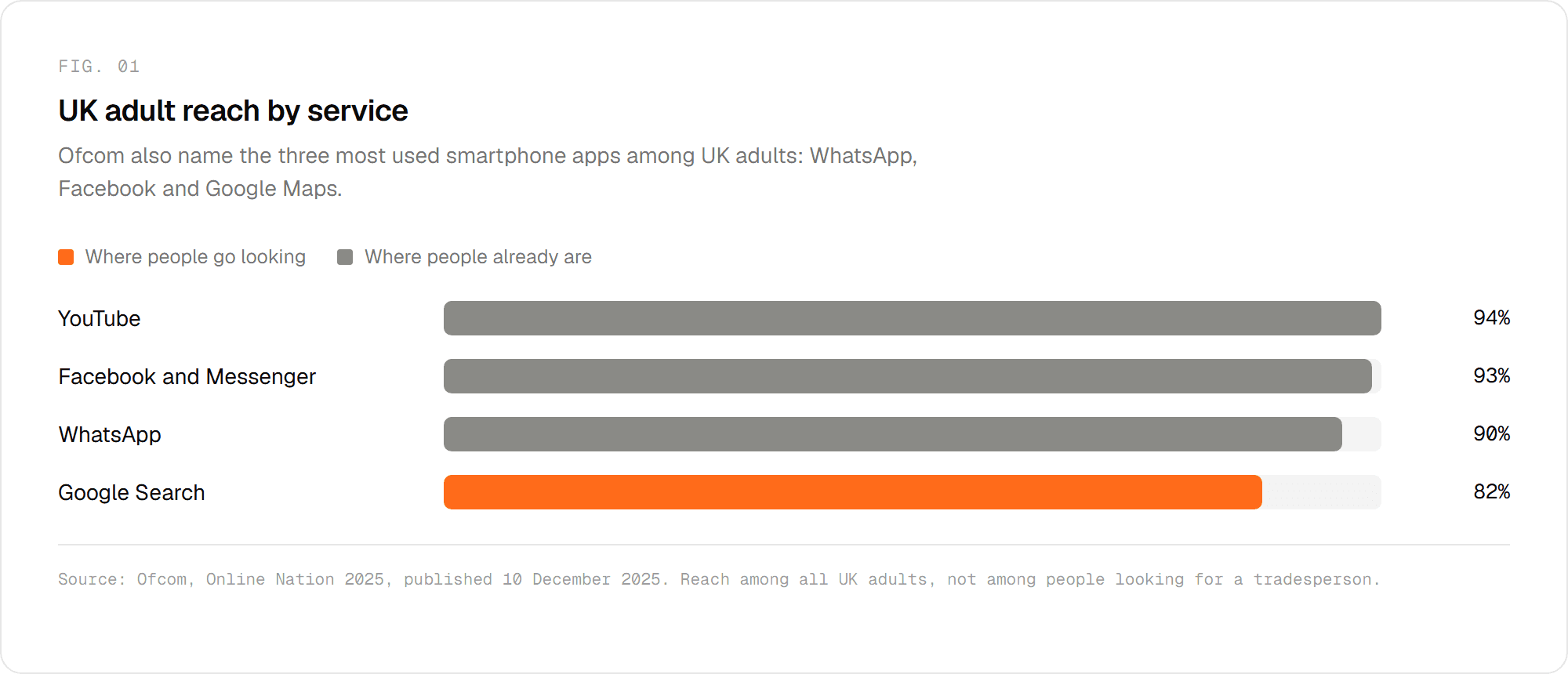
Ofcom also name the three most commonly used smartphone apps among UK adults: WhatsApp, Facebook and Google Maps.
Google Maps being in that three is the part trades should care about most. It is not a social app or a search engine, it is the thing people open when they want somebody local, and your Google Business Profile is the whole of your presence inside it.
AI has already changed what a search looks like
This is the bit that has moved fastest, and Ofcom put numbers on it.
About 30% of searches now show an AI overview. More than half of UK adults, 53%, say they see those summaries often. Ofcom add a line that matters: "in most cases, they aren't seeking these but finding them now included by their search services." Nobody opted in. It just turned up.
And people are going straight to the AI as well. ChatGPT had 1.8 billion UK visits in the first eight months of 2025, against 368 million in the same period of 2024.
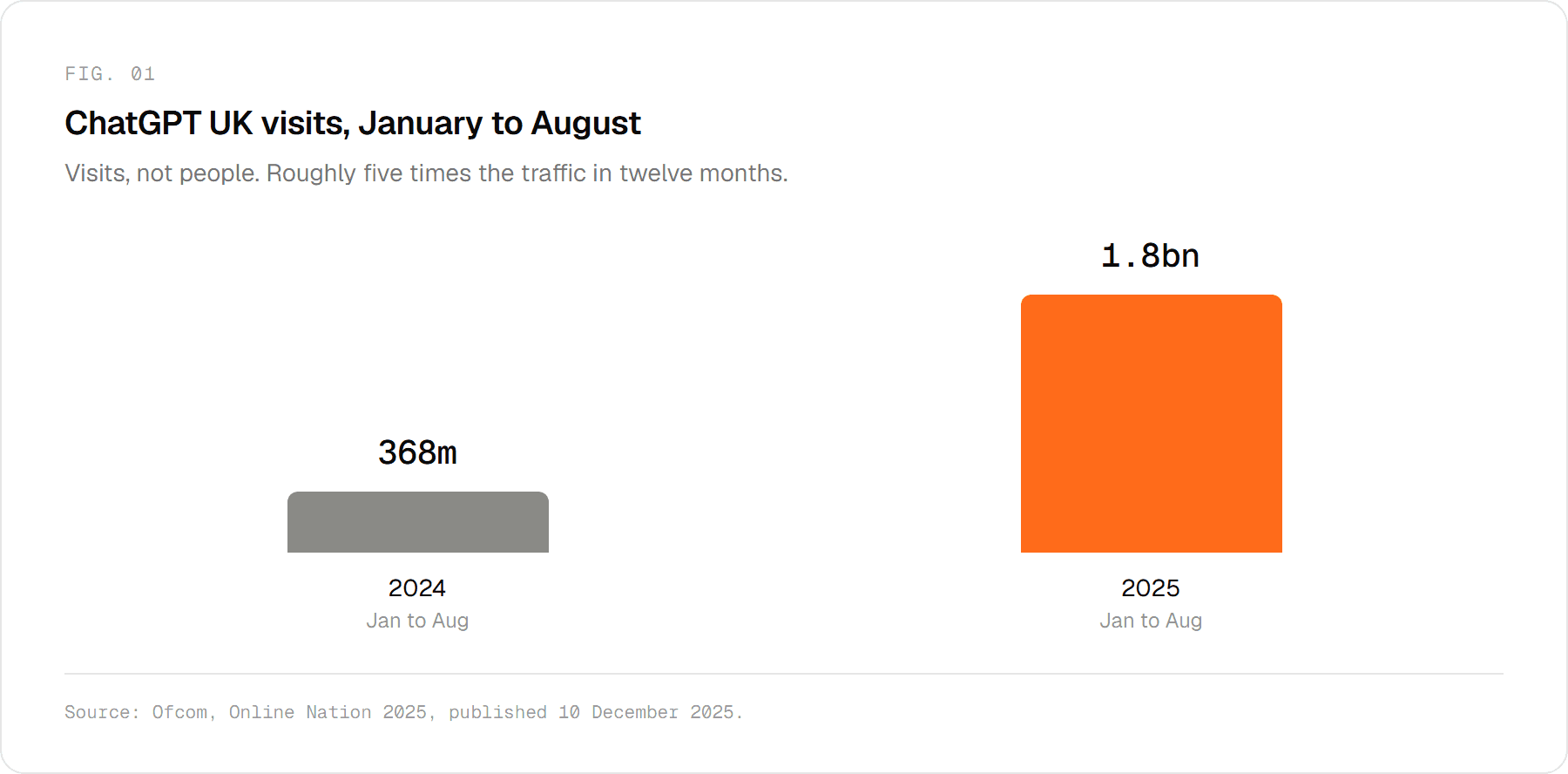
That is roughly five times the traffic in twelve months. I do not know a single trade business that has changed anything because of it.
What that actually means for a trade business
The old version of this was one job: rank on Google. The current version is four surfaces, and they need different things.
1. The map. Google Maps and the local pack. Won on your Google Business Profile: categories, service areas, photos, and reviews that keep arriving. This is still where most emergency and near-me work comes from and it is the cheapest thing on this list to fix.
2. Ordinary search results. Pages on your own site about the work you do and the towns you do it in. Slow, compounding, and still the only asset here that you own.
3. The AI answer. When somebody asks ChatGPT or reads a Google AI overview, the model has to find something to say about you. It reads your site, your profile, directories, and reviews. If those disagree with each other, or there is nothing there, you do not get mentioned.
We have seen this work. Google's AI Overview cites our client LMB Plumbing and Heating by name. That was not a fluke of one search on one day, we check it, but it is also not a guarantee, because these results move around and any agency telling you they can lock in an AI citation is guessing.
4. The feed. Meta, mostly. Nobody on Facebook is looking for a plumber, which is exactly why it works differently. It creates the demand rather than catching it, and it is where you go when the map and the search results are already doing their job and you want more than your area is searching for.
The order to do it in
Not all four at once. In this order, because each one makes the next one work better.
Google Business Profile, properly finished. Every category, every service, real photos, and a system that asks for a review after every job. If your profile is thin, everything downstream of it is thin.
A site that says what you do and where. Real pages, not one page with a phone number on it. This is what the AI reads.
Make sure your details match everywhere. Name, address, phone, opening hours. Same on your site, your profile, and every directory you are listed in. Disagreement is the single most common reason a business gets left out of an AI answer.
Then paid. Meta first for most trades, Google Search for the ones with genuine buying-intent volume in their area. We have written before about why we do not run Google Ads for our own agency.
Measure which one produced the job. Not "the phone's been busy". Which channel it came from, and what the job was worth.
The uncomfortable bit
Everything above is measurable. Most trades cannot tell you where their last ten jobs came from, which means they cannot tell whether anything they are paying for works.
We do that measurement for every client we take on before we change a single thing, because the first month of numbers usually contradicts what the owner believed, and that is the useful part.
What this article does not claim
The Ofcom figures are UK adults across all activity. They are not "94% of your customers find you on YouTube". They tell you where attention is, not where trade enquiries come from.
The ChatGPT figure is visits, not people, and it covers January to August 2025.
The AI Overview citation for LMB is real and we monitor it. AI results are volatile. Nobody can promise one.
Ofcom's "30% of searches show an AI overview" is a snapshot from their 2025 report. Google changes this constantly.
Sources
Ofcom, Online Nation 2025, published 10 December 2025. All reach figures, search volumes, AI overview percentages and ChatGPT visit figures are Ofcom's.
First-party: BetterWays monitoring of Google AI Overview citations for LMB Plumbing and Heating.

Matthew Betts

