Is AI going to take over the trades?

AI


Somebody asks me this on nearly every call now, usually near the end, half joking. A gas engineer in his forties who has just watched a video about robots wants to know if his lad should still do the apprenticeship.
So I went and read what the government has actually measured, rather than what LinkedIn thinks.
The short version: the UK government's own research puts building trades among the least exposed jobs in the country, and the most exposed are the office jobs that people assumed were safe. But something else is changing, and it is already costing trades work.
What the government actually measured
The Department for Education published "The impact of AI on UK jobs and training" in November 2023. They scored every occupation for how exposed it is to AI and to large language models.
Here is their sentence about the jobs at the bottom of the list, the ones AI is least likely to touch:
"The occupations least exposed to AI and LLM include many of the same areas, including more manual work that is technically difficult, in unpredictable environments, and with lower wages (reducing the incentive to automate) ... This includes: roofers, roof tilers and slaters; elementary construction occupations; plasterers; and steel erectors."
That is the Department for Education naming building trades as among the safest work in Britain.
Now the other end of the same report. The most exposed occupations are professional ones, especially clerical work and anything in finance, law and business management. They name management consultants, business analysts, financial managers and directors, chartered and certified accountants. Finance and insurance is the most exposed sector of the whole economy.
And this line, which is the one I would put on a poster in every school:
"Employees with more advanced qualifications are typically in jobs more exposed to AI."
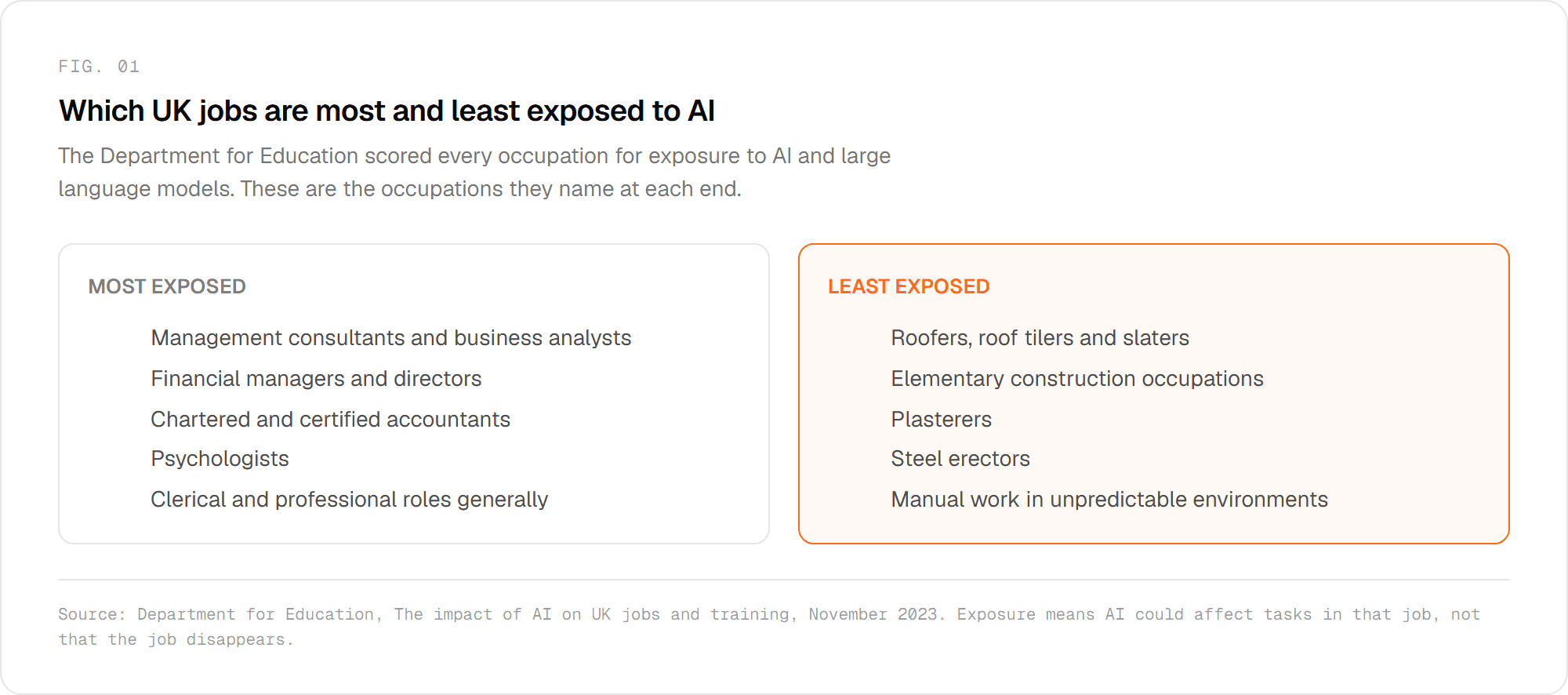
The lad doing the plastering apprenticeship is in a safer job than his mate doing the accountancy degree. That is not my opinion, it is the government's own scoring.
Why the trades come out safest
The report gives the reason plainly. Manual work that is "technically difficult, in unpredictable environments".
Think about what that actually means on a job. No two houses are the same. The pipework is where somebody put it in 1974, not where the drawing says. Half the job is deciding what the actual problem is while lying on your side in a cupboard. Then there is the bit where you have to convince a nervous homeowner that the thing you found is worth fixing.
A machine that can do all of that is not a plumbing robot. It is a general-purpose robot, and nobody has one.
There is an older piece of work worth knowing about too. The ONS analysed the jobs of 20 million people in England in 2017 and found 7.4% at high risk of automation, where high risk means above a 70% probability. The three highest were waiters, shelf fillers and elementary sales. The three lowest were medical practitioners, higher education teachers and senior education professionals.
Worth saying: the ONS did not put a number on plumbers or electricians. There are figures doing the rounds like "electricians 15%" and "plumbers 35%" with the ONS's name attached. I went looking for them in the actual article and they are not in it. Somebody made them up and everyone copied it.
So what is actually changing
This is the part that matters, and almost nobody frames it right.
AI is not coming for the job. It has already changed the queue.
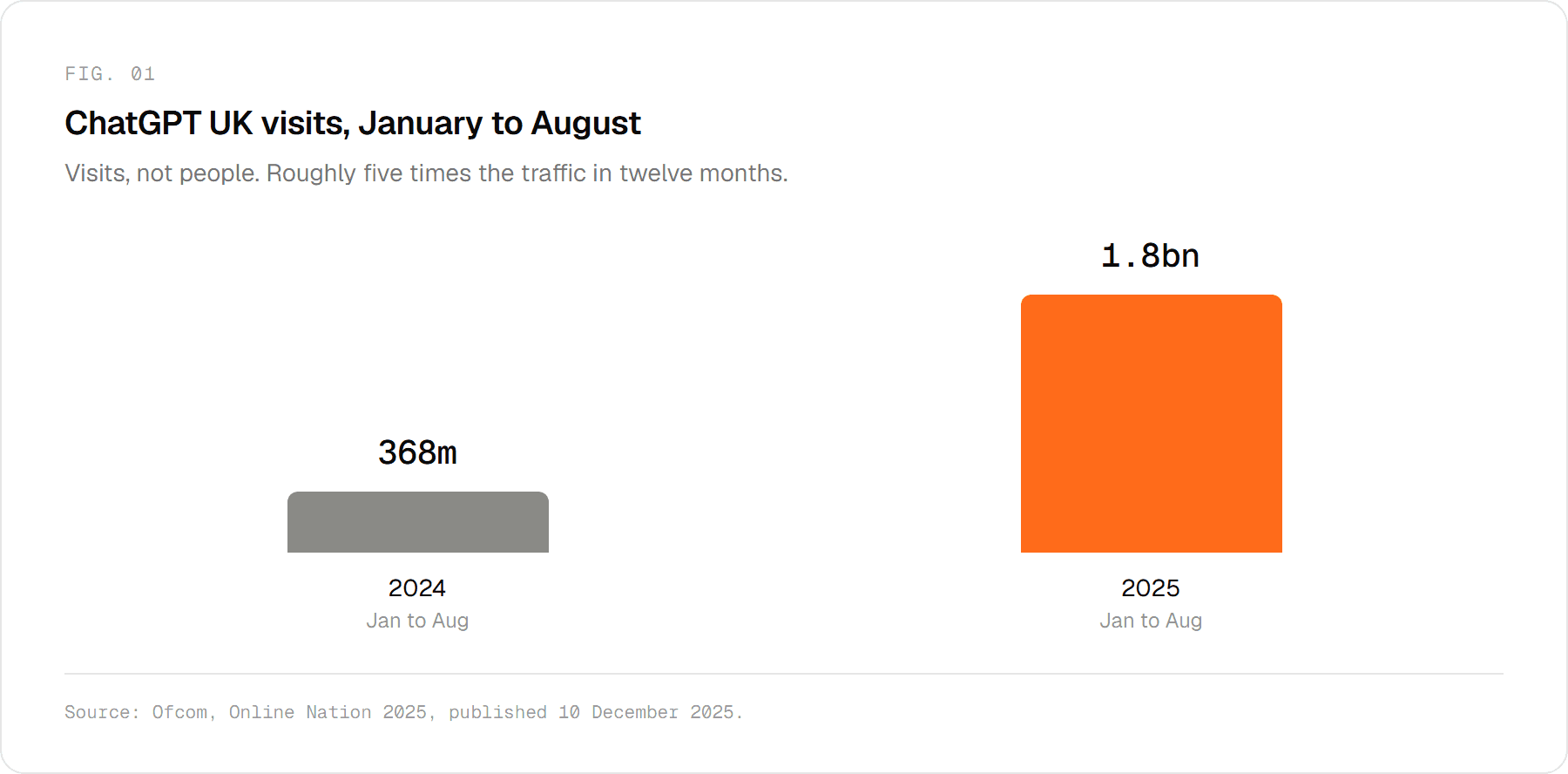
Ofcom's Online Nation report, December 2025, says about 30% of Google searches now show an AI summary, and 53% of UK adults say they see those summaries often. Ofcom add that in most cases people "aren't seeking these but finding them now included by their search services". Meanwhile ChatGPT went from 368 million UK visits in the first eight months of 2024 to 1.8 billion in the same period of 2025.
So a homeowner with a leak asks a machine, and the machine names three local plumbers. If you are not one of them, you never find out the conversation happened. There is no missed call, no unanswered email, nothing in your inbox. You are just not in the answer.
That is the real risk, and it is nothing to do with robots holding a spanner.
We have seen the other side of it too. Google's AI Overview cites our client LMB Plumbing and Heating by name. We monitor it, because these results move about and anyone promising you a permanent spot in an AI answer is guessing. But it happens, and when it does you get work from a search you never even ranked for in the old sense.
Where AI is genuinely useful to you now
Not the sci-fi version. The boring version, which is the one making people money.
Answering the phone when you cannot. An automatic text back the second a call is missed. Seven in ten people who reach a voicemail hang up without leaving a message, so this is the single highest-return automation for a trade business. There is a whole article on that.
Chasing your own quotes. The follow-up you never get round to on a Sunday night. Written once, sent automatically, replies land somewhere you will actually see them.
Writing the boring stuff. Job descriptions for your website, the service pages for the towns you cover, review requests. It is decent at this and it is quick.
Sorting the phone. Which jobs came from where, what they were worth, which of your marketing is actually working.
What it is not good at, and I would not let it near: pricing your jobs, talking to a customer as if it were you, or writing anything that claims a qualification or a guarantee you do not have.
What I would tell the gas engineer
Do the apprenticeship. Your job is one of the last ones a machine gets to, and the government's own numbers say so.
Then spend a fortnight sorting how people find you and what happens when they ring, because that is the part AI has already changed, and the lad down the road who sorts it first will have your work.
What this article does not claim
The DfE report scores exposure, not job losses. Exposure means AI could affect tasks in that job, not that the job disappears. Low exposure is not a guarantee of anything.
The ONS work is from 2019 and models task automation, not the generative AI everyone means today. I have used it for context, not as a forecast.
Neither study puts a specific number on plumbers, electricians or gas engineers. The trades the DfE names are roofers, tilers, slaters, plasterers, steel erectors and elementary construction.
The Ofcom figures are UK adults across all searching, not people looking for a tradesperson. Nobody publishes that number.
The LMB AI Overview citation is real and monitored, but AI results are volatile and no agency can promise one.
Sources
Department for Education, "The impact of AI on UK jobs and training", November 2023.
Office for National Statistics, "Which occupations are at highest risk of being automated?", 25 March 2019. Analysis of 20 million jobs in England in 2017.
Ofcom, Online Nation 2025, published 10 December 2025.
First-party: BetterWays monitoring of Google AI Overview citations for LMB Plumbing and Heating.

Matthew Betts

